


Why Waterproofing Before Tiling Matters in Bathrooms, Terraces and Pools
A beautifully tiled bathroom can still leak.
An expensive rooftop terrace can still cause damp patches on the ceiling below.
And a perfectly tiled swimming pool can still lose water.
Why?
Because tiles are not waterproofing. Grout is not waterproofing. And tile adhesive should not be expected to replace a properly designed waterproofing system.
For the Ghanaian builder, contractor, tiler and homeowner, one of the most important lessons in modern construction is this:
WATERPROOF FIRST. TILE AFTER.
This is particularly important in bathrooms, washrooms, kitchens, balconies, terraces, swimming pools, water tanks and other permanently or frequently wet areas.
One practical cementitious solution available to us is SikaTop® Seal-107.
Sika Ghana lists SikaTop® Seal-107 as part of its waterproofing systems for wet areas as well as swimming pools and water tanks.
What Exactly Is SikaTop® Seal-107?
SikaTop® Seal-107 is a two-component, polymer-modified cementitious waterproofing slurry.
In the current Sika formulation for hot and tropical climatic conditions, the system consists of:
Part A: liquid polymer and additives
Part B: cement, selected aggregates and special admixtures.
The components are pre-batched and mixed together to produce a cementitious slurry that bonds to properly prepared concrete, mortar and masonry substrates.
Its job is simple but extremely important:
Create a continuous waterproof barrier between the structure and the water before the final finishes are installed.
Sika specifies this type of SikaTop Seal-107 system for waterproofing wet areas, terraces and balconies beneath screeds and tiles, as well as hydraulic structures such as tanks and basins.
🚿 1. THE BATHROOM: DON’T ALLOW WATER TO FIND THE ROOM BELOW
One of the most common mistakes in Ghanaian residential construction is:
Screed → Tile adhesive → Tiles → Grout.
No dedicated waterproofing membrane.
The assumption is that because the floor has been tiled, water cannot get through.
Unfortunately, water does not need a large hole.
It can migrate through grout lines, corners, penetrations, cracks, poorly sealed pipework and other weak points.
Eventually you may notice:
- dampness on the ceiling below an upstairs bathroom;
- peeling paint;
- staining around walls;
- mould;
- damaged plaster;
- swollen timber finishes;
- or complaints from the occupants downstairs.
The correct philosophy should be:
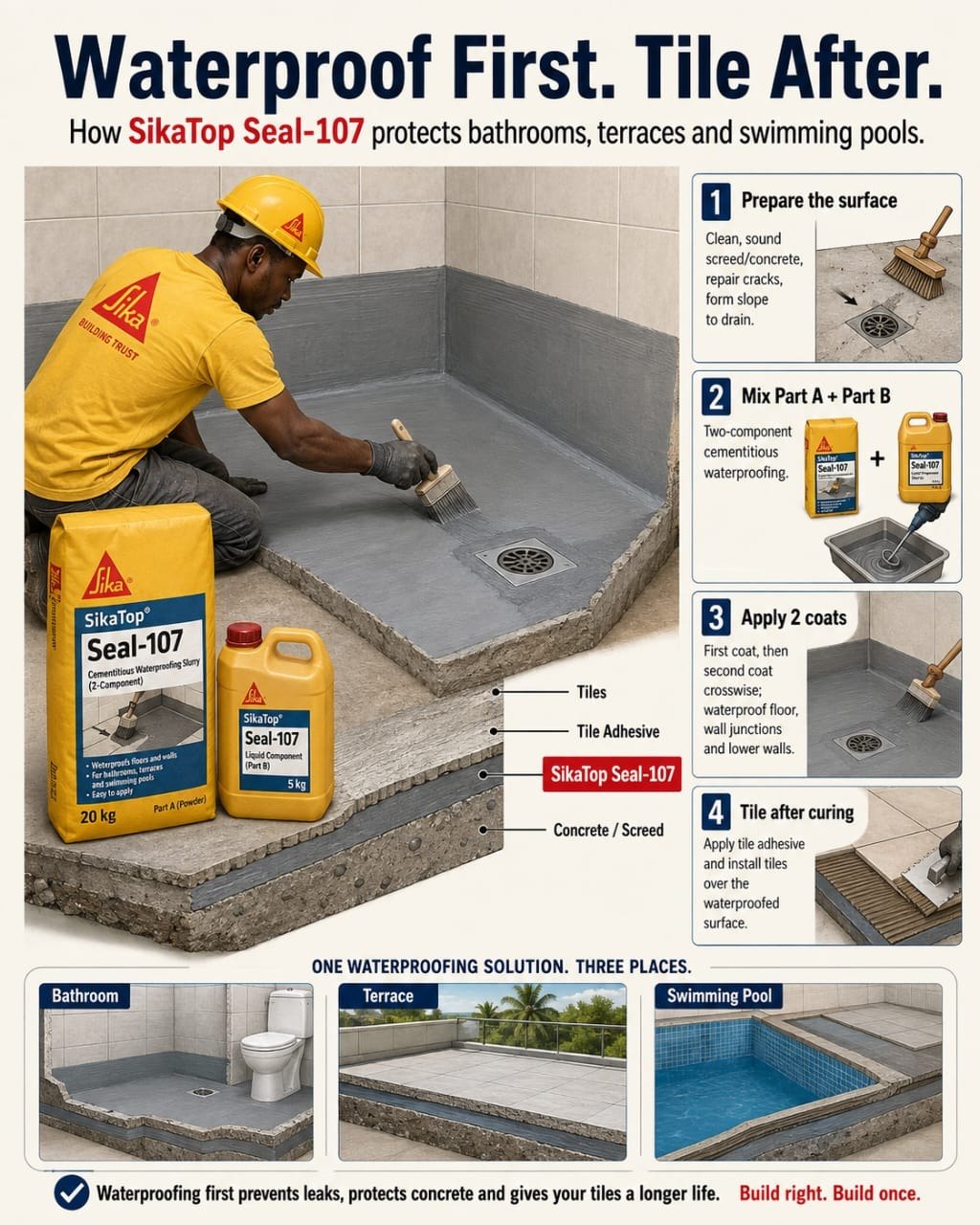
Concrete/screed → properly prepared substrate → SikaTop Seal-107 waterproofing → protection/tile system → finished tiles.
This means that even if water gets through the tile or grout layer, it meets a waterproofing layer beneath it instead of immediately entering the structure.
Sika identifies bathrooms and other wet areas as applications requiring waterproofing systems specifically intended to protect against water ingress.
🏢 2. TERRACES: THE TILES ARE EXPOSED TO MUCH MORE THAN YOU THINK
A tiled terrace in Ghana experiences:
☀️ intense sunshine
🌧️ heavy rainfall
🔥 heating during the day
🌙 cooling at night
💧 standing or wind-driven water
🏗️ movement within screeds and substrates
This repeated exposure makes waterproofing underneath the finished surface extremely important.
A terrace may look perfect from above while the slab beneath it is gradually transmitting moisture into bedrooms, offices or living spaces below.
Sika specifically lists cementitious waterproofing beneath terraces, balconies, protection screeds and tiles as an application for SikaTop Seal-107 systems.
But waterproofing cannot compensate for poor drainage.
The terrace must still have the correct falls towards outlets, properly treated drains and penetrations, and sound construction details.
Remember:
Waterproofing stops water penetration. Good slope stops water accumulation. You need both.
🏊 3. SWIMMING POOLS: HERE THE WATER NEVER LEAVES
If waterproofing is important in a bathroom, it becomes even more critical in a swimming pool.
A shower floor may experience water for a few minutes at a time.
A swimming pool may hold thousands of litres of water 24 hours a day, seven days a week.
That means the pool shell, corners, wall-to-floor junctions, pipe penetrations, lights, drains and construction joints must all be treated as part of one waterproofing system.
Sika Ghana specifically categorises SikaTop Seal-107 as a waterproofing solution for swimming pools and water tanks.
The waterproofing goes onto the properly prepared pool structure before the pool tiles are installed.
The tiles then become the decorative and protective finish.
The waterproofing membrane is what protects the structure.
That distinction is extremely important.
🧱 HOW SHOULD SikaTop® Seal-107 BE APPLIED?
Effective waterproofing begins long before somebody picks up a brush.
Step 1 — Prepare the Substrate Properly
The concrete or cementitious surface must be:
sound, clean and properly prepared.
Remove contaminants, weak material, laitance, dust and anything that could interfere with adhesion.
Honeycombs, significant voids and defective areas should be properly repaired first.
Structural cracks should also be identified and treated appropriately rather than simply painted over with waterproofing slurry. Sika specifically notes that structural cracks require appropriate treatment.
Step 2 — Pay Special Attention to the DETAILS
Many waterproofing failures do not occur in the middle of a perfectly flat floor.
They occur at:
wall-to-floor junctions, internal corners, external corners, drain outlets, pipe penetrations, construction joints, changes in level, movement joints, around fittings
These areas deserve deliberate waterproofing detailing.
A contractor should never proudly show you the waterproofing in the middle of the bathroom while ignoring the pipe coming through the wall.
Water will always look for the weakest detail.
Step 3 — Pre-Dampen the Cementitious Surface
For hot or absorbent substrates, Sika’s current tropical-climate guidance calls for the prepared substrate to be pre-dampened before application without leaving standing water.
The target is essentially a saturated-surface-dry condition rather than a dusty, bone-dry surface or a surface covered with puddles.
This is especially relevant on Ghanaian sites where concrete and screeds can become very hot and dry before waterproofing begins.
Step 4 — MIX THE PRODUCT CORRECTLY
This is not ordinary cement slurry.
Do not buy a waterproofing system and then allow somebody on site to casually modify the formulation.
For the current two-component SikaTop Seal-107 SA system, the stated mixing ratio is:
Part A : Part B = 1 : 4 by weight.
The product is mechanically mixed at low speed until a uniform, lump-free consistency is obtained. Sika states that additional water should not be introduced into the pre-batched system.
That liquid component is there for a reason.
Do not replace the polymer with water because somebody wants the material to “go far.”
You may save material today and pay for a leaking bathroom tomorrow.
Step 5 — APPLY AT LEAST TWO COATS
Waterproofing should form a continuous layer, not random brush marks.
The current Sika tropical-climate data recommends a minimum of two coats, with the second coat applied in a crosswise direction to the first after the first has hardened sufficiently.
The specified layer thickness is approximately:
Minimum 0.75 mm per coat
Maximum 1.5 mm per coat
With at least two layers required for waterproofing or damp-proofing applications. Severe water exposure may require an additional coat depending on the specification and site conditions.
This is why simply saying:
“We applied waterproofing.”
is not enough.
Ask:
How many coats? What total thickness? How was it applied? Were the details treated?
📐 HOW MUCH SikaTop® Seal-107 WILL YOU NEED?
The current tropical SikaTop Seal-107 technical data gives a theoretical consumption of approximately:
2.0 kg/m² per millimetre thickness.
So if the specification requires a total waterproofing thickness of around 1.5 mm, the theoretical material requirement is approximately:
2.0 kg × 1.5 mm = 3.0 kg/m²
Therefore, a 25 kg set would theoretically cover around:
25 ÷ 3 ≈ 8.3 m²
at that total thickness.
But this is theoretical.
Actual site consumption will be affected by:
- substrate roughness;
- porosity;
- irregularities;
- detailing;
- application losses;
- wastage.
Sika expressly notes that its theoretical consumption does not include extra material required because of surface profile, porosity and site wastage.
So don’t measure your bathroom at exactly 8.3 m² and buy exactly one set without allowance.
⚠️ DON’T FORGET: SikaTop Seal-107 IS A RIGID CEMENTITIOUS SYSTEM
This distinction matters.
Sika describes this type of Seal-107 as a rigid waterproofing system and indicates it for sealing fine hairline cracks that are not subject to movement.
Therefore, active cracks, expansion joints, significant movement joints and other moving details require appropriate treatment rather than simply coating over them and hoping for the best.
For areas where substantial movement or crack-bridging capability is expected, the complete waterproofing specification may require a different or supplementary system.
Product selection must follow the movement and exposure conditions of the structure.
🧪 WATER TEST BEFORE YOU TILE
This is one of the cheapest quality-control exercises on the entire project.
Once the waterproofing has been properly applied and cured in accordance with the specification, test the area appropriately before covering it permanently with tiles or screed.
For a bathroom or similar wet area, an appropriately conducted flood/ponding test can help identify defects while you can still see and repair the waterproofing.
Imagine discovering the leak:
before tiling: repair the waterproofing.
Discovering the leak:
after tiling: remove grout, tiles, adhesive and possibly screed, locate the defect, repair it, then replace everything.
The difference in cost can be enormous.
DON’T LET THE TILER DESTROY THE WATERPROOFING
Another overlooked problem occurs after successful waterproofing.
The tiler arrives.
Then someone drills through the membrane.
Or scratches it.
Or fixes something mechanically through it.
Or damages the coating while moving materials.
Sika warns that waterproofing coatings must be protected against puncturing from subsequent fixings.
After waterproofing, every trade working in that area needs to understand:
THE MEMBRANE IS NOW PART OF THE BUILDING’S WATER DEFENCE.
Protect it.
🏗️ THE GHANAIAN BUILDER’S CORRECT SEQUENCE
For a typical tiled wet area, think:
- Sound concrete/screed
- Repair cracks, honeycombs and defective areas
- Form proper falls and drainage
- Detail corners, penetrations, drains and joints
- Apply SikaTop® Seal-107 correctly
- Minimum two properly applied coats
- Allow the system to cure
- Test where appropriate
- Protect the waterproofing
- Install the specified tile adhesive and tiles
- Grout and seal the required joints
That is a waterproofing system.
Simply applying tiles is not.
💡 THE BIG LESSON
Ghanaian builders spend considerable money on:
Italian tiles.
Spanish tiles.
Large-format porcelain.
Decorative mosaics.
Premium sanitaryware.
Beautiful swimming pool finishes.
Yet the waterproofing underneath—the part nobody will see after construction—is sometimes treated as unnecessary expenditure.
That thinking needs to change.
Because once the building is occupied, the invisible waterproofing layer may prove more valuable than the expensive tile sitting on top of it.
Sika notes that waterproofing is largely invisible after construction but protects structures against water infiltration that can otherwise cause costly deterioration.
DON’T TILE OVER A PROBLEM.
WATERPROOF IT FIRST.
Whether it is your:
🚿 Bathroom
🏊 Swimming pool
🏢 Terrace
🌴 Balcony
💧 Water tank
🧱 Wet area
build the waterproofing into the construction before installing the beautiful finish.
SikaTop® Seal-107: Put the waterproofing where the water cannot bypass it.
Because tiling is a finish. Waterproofing is protection.

