


What Does a Concrete Curing Compound Do?
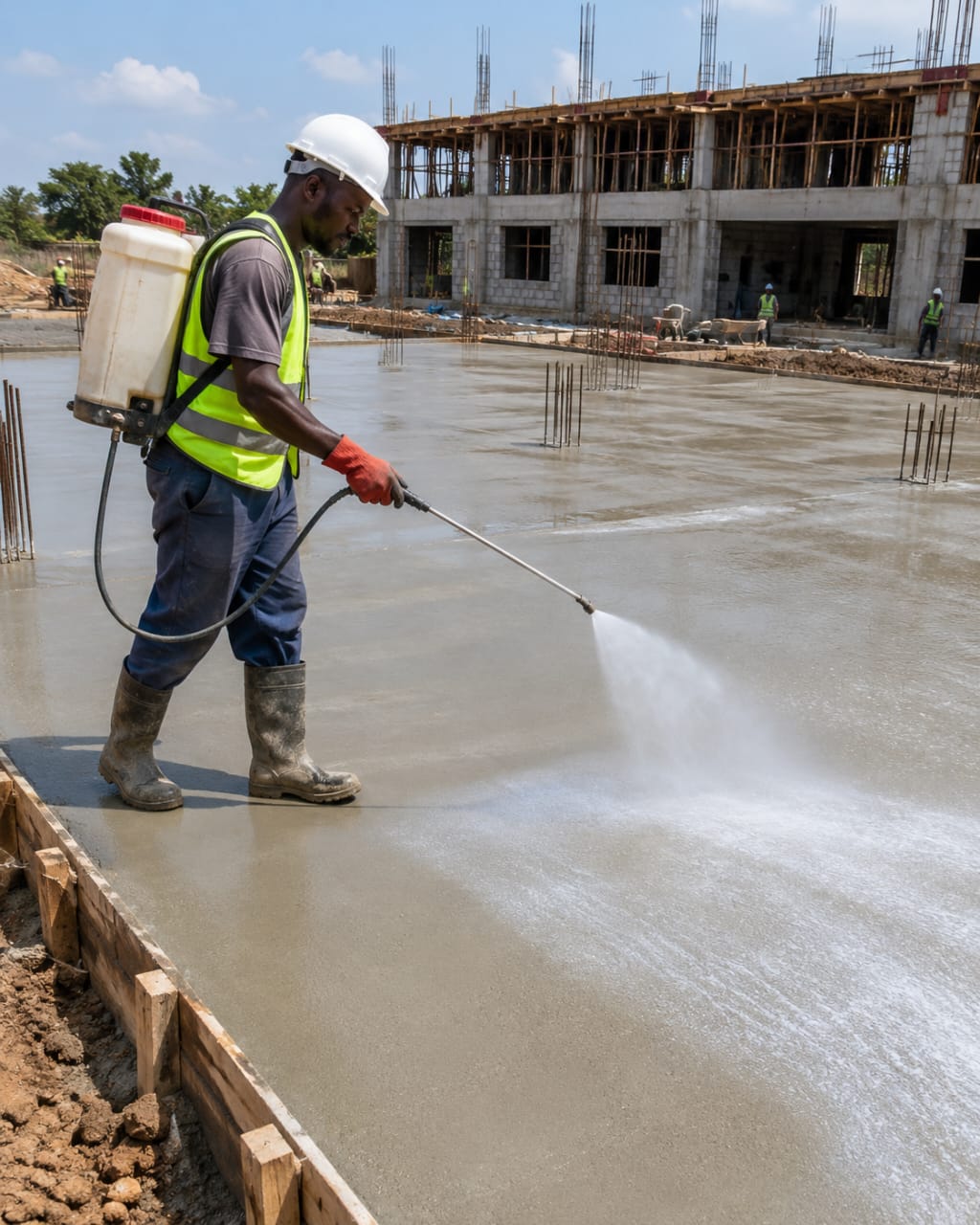
A curing compound is applied to the surface of newly placed concrete.
It forms a thin membrane that reduces the rate at which moisture escapes from the concrete.
Think of it as:
KEEPING THE WATER THE CEMENT NEEDS INSIDE THE CONCRETE FOR LONGER.
That allows hydration to continue more effectively while reducing rapid surface drying.
It does not mean that the curing compound magically strengthens poor concrete.
Instead, it helps the concrete you have already produced develop its intended properties by protecting the moisture required for curing.
✅ WEBER.AD CURE Y 40
The correct product name is weberad cure Y 40.
It is a water-based curing compound designed for newly placed concrete.
Once applied, it forms a moisture-resistant membrane on the surface to help retain moisture, support cement hydration and reduce plastic shrinkage cracking. Saint-Gobain also identifies improved strength and durability among its benefits.
It can be used on fresh concrete slabs and other concrete surfaces where moisture loss needs to be controlled.
HOW IS IT APPLIED?
Weber specifies that once the surface gloss becomes matt and bleeding has stopped, weberad cure Y 40 can be sprayed onto the concrete using a hand-operated spray gun. It can also be applied by roller or brush.
The current Weber technical data gives an approximate consumption of:
8 m² per litre
subject to actual surface and site conditions.
That makes curing something that can be planned and measured rather than left to chance.
✅ SIKA® ANTISOL®
Sika also provides a range of Antisol curing compounds for newly placed concrete.
For example, Sika Antisol E is a ready-to-use spray-applied curing agent that forms a thin-film barrier to reduce water loss from freshly placed concrete. Sika Ghana lists benefits including reduced cracking and shrinkage, improved strength development and reduced surface dusting. It specifically includes roof decks and industrial floor slabs among its applications.
Sika Ghana gives a theoretical consumption of approximately:
0.15–0.20 kg/m² for Sika Antisol E
depending on environmental and substrate conditions. It is sprayed in a fine mist to completely cover the concrete surface.
There are also other products in the Antisol range.
For example, Sika Antisol-90 is specifically identified by Sika Ghana as suitable for hot and tropical climatic conditions. It forms a thin membrane over fresh concrete to reduce rapid evaporation and is intended to reduce plastic cracking, shrinkage and surface dusting while assisting strength development.
Sika specifies approximately:
5.3–5.7 m² per litre for Antisol-90
with application to fresh concrete after the free surface water has evaporated.
The exact Antisol grade should therefore be selected according to the project requirements and subsequent surface treatments.
⚠️ IMPORTANT: THINK ABOUT WHAT WILL GO ON TOP OF THE CONCRETE LATER
This point is often forgotten.
A curing compound forms a membrane.
So if you later intend to install:
- waterproofing;
- epoxy flooring;
- tiles;
- cementitious screed;
- protective coatings;
- bonding mortars;
- or other finishes,
you must check compatibility with the curing compound.
For example, Weber specifically advises checking adhesion and compatibility before overcoating concrete treated with weberad cure Y 40.
Sika Antisol-90 also requires its residual membrane to be removed where subsequent treatment is applied before the membrane has naturally disintegrated.
So curing must be considered as part of the whole construction sequence, not in isolation.
BUT CURING COMPOUND WILL NOT SOLVE EVERY CRACK
This distinction is extremely important.
Looking at a cracked slab and saying:
“Just use Antisol next time”
is too simplistic.
Cracks can also result from:
- inadequate reinforcement;
- structural overloading;
- poor subgrade compaction;
- settlement;
- incorrect slab thickness;
- missing or badly located movement/control joints;
- thermal movement;
- plastic settlement around reinforcement;
- weak concrete;
- excessive water;
- or structural movement.
A curing compound primarily helps address moisture loss and curing-related shrinkage risks.
It cannot compensate for poor structural design or poor construction.
For a slab showing extensive cracking like the one pictured, the crack widths, depths, timing, structural arrangement and substrate conditions should therefore be investigated before deciding that the cracks are merely cosmetic.
🏗️ THE BETTER GHANAIAN SLAB-CASTING ROUTINE
Before casting:
1. Check the mix design
Control the water-cement ratio. Do not allow uncontrolled site water addition.
2. Check the weather
Pay attention to heat, wind and exposure.
3. Prepare your curing materials BEFORE the pour
Do not start looking for curing materials after finishing the slab.
4. Place and compact correctly
Avoid poor consolidation and segregation.
5. Finish at the correct time
Do not finish bleed water back into the concrete.
6. START CURING IMMEDIATELY WHEN THE SURFACE CONDITION ALLOWS
This is where products such as:
WEBER.AD CURE Y 40
and
SIKA ANTISOL
become extremely useful.
7. Apply uniformly
A curing compound only works properly where you actually cover the concrete.
Missing patches become weak points in your curing programme.
8. Protect the slab
Control premature traffic, impact and other construction activities.
9. Provide the designed joints
Curing reduces shrinkage cracking risk; it does not eliminate the need for correctly designed movement and contraction joints.
CURING IS NOT AN EXTRA COST. IT PROTECTS THE MONEY YOU HAVE ALREADY SPENT.
Think about what has already gone into that slab:
cement
aggregates
reinforcement
formwork
concrete pumps
labour
equipment
transport
engineering
Then the concrete is placed—
and somebody decides that curing is too expensive.
That is false economy.
A relatively small curing operation is protecting a much larger investment in concrete.
If poor curing contributes to cracking, surface dusting, weak surface concrete or reduced durability, the remedial costs can greatly exceed what proper curing would have cost during casting.
THE BIG LESSON
Concrete does not become strong simply because it has become hard enough to walk on.
After placement, the cement still requires appropriate moisture and temperature conditions to continue hydration and develop the properties for which the concrete was designed.
So when you finish casting a slab, don’t ask:
“Have we finished concreting?”
Ask:
“HOW ARE WE CURING IT?”
Whether your curing method involves carefully controlled wet curing or a suitable membrane-forming curing compound such as:
WEBER.AD CURE Y 40
or
SIKA® ANTISOL®
the principle remains the same:
KEEP THE MOISTURE IN.
ALLOW THE CEMENT TO HYDRATE.
REDUCE EARLY SHRINKAGE.
GIVE YOUR CONCRETE THE OPPORTUNITY TO DEVELOP ITS DESIGNED STRENGTH AND DURABILITY.
Casting the concrete is only half the job. Proper curing finishes it.

