


Why Concrete Shrinkage Cracks Develop and Why Proper Curing Matters
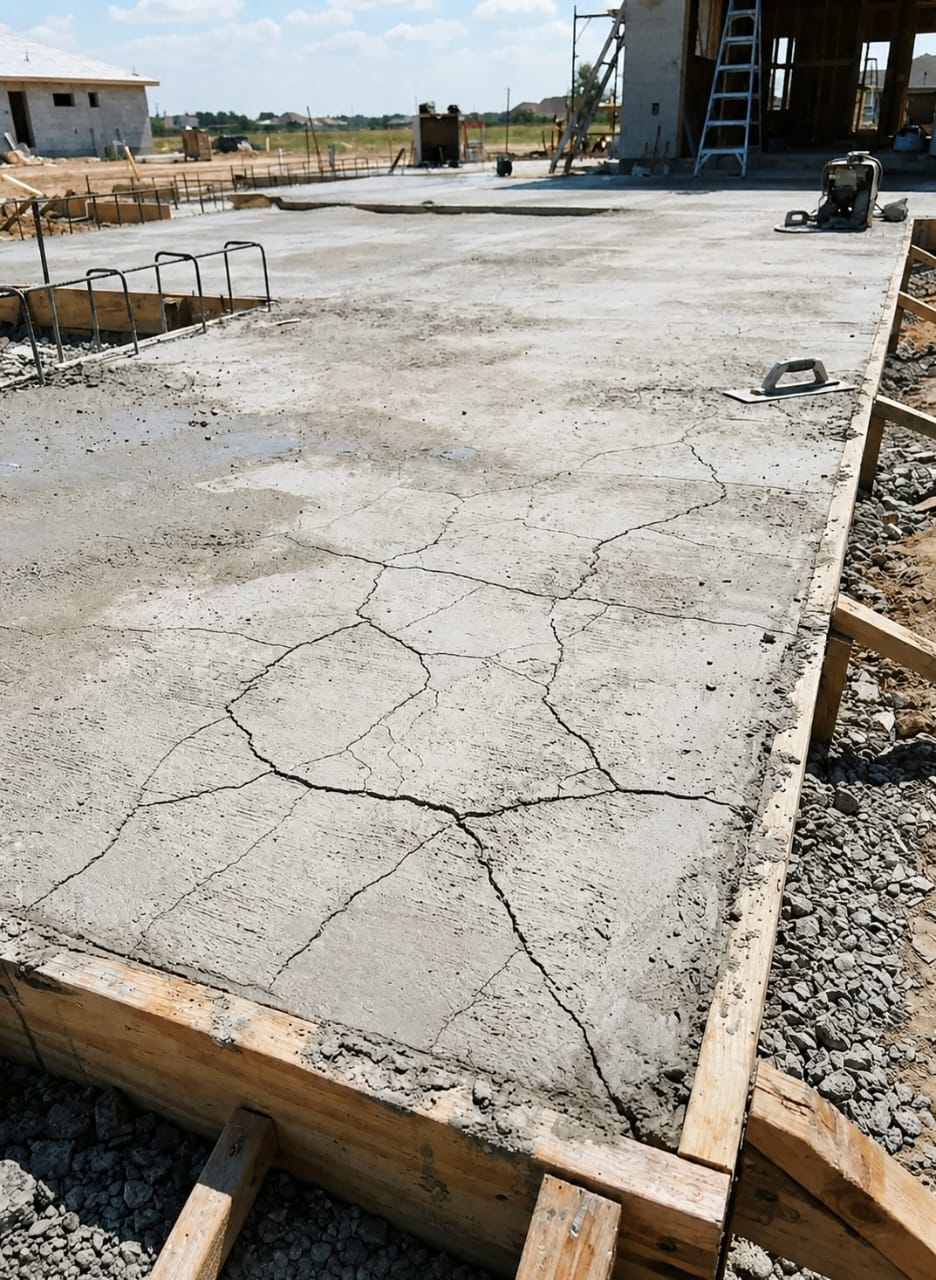
Your concrete slab has been cast. But have you actually finished the job??
You cast a beautiful concrete slab in the morning.
The concrete is levelled.
The mason finishes the surface.
Everybody packs up and leaves.
A few hours later—or the following day—you begin seeing cracks spreading across the slab.
Then the questions start:
“Was the cement bad?”
“Was there not enough iron rods?”
“Should we have added more cement?”
Not necessarily.
One of the most overlooked causes of early cracking in concrete slabs is much simpler:
THE CONCRETE LOST WATER TOO QUICKLY AND WAS NOT PROPERLY CURED.
For the Ghanaian builder, where concrete is frequently cast under strong sunshine, warm temperatures and sometimes significant wind, curing should never be treated as an afterthought.
The American Concrete Institute defines curing as maintaining satisfactory moisture and temperature conditions long enough for cement hydration to develop the intended properties of the concrete. Proper curing is essential to achieving the potential strength and durability of the concrete.
FIRST: WHY DOES CONCRETE SHRINK?
Concrete contains water for two very different reasons.
Some water is required for the chemical reaction between cement and water known as hydration.
Additional water also provides the workability needed to mix, place and compact the concrete.
After concrete is placed, however, moisture begins leaving the exposed surface.
If the surface loses moisture too quickly while the concrete is still young, the concrete begins trying to contract or shrink.
If that contraction is restrained by the rest of the concrete, reinforcement, beams, columns, foundations or other structural elements, tensile stresses develop.
Concrete is relatively weak in tension—particularly when it is very young.
The result?
CRACKS.
1. PLASTIC SHRINKAGE CRACKING — SOMETIMES WITHIN HOURS OF CASTING
This is one of the first risks after pouring a large slab.
While the concrete is still plastic, water naturally rises towards the surface as bleed water.
But imagine that you have:
☀️ strong sunshine
🌡️ high concrete temperature
💨 moving air or strong wind
🏗️ a very large exposed slab
If surface evaporation occurs faster than moisture can replace it from within the fresh concrete, the surface begins drying and contracting while the concrete is still weak.
That creates plastic shrinkage cracks.
ACI identifies high temperature, low relative humidity and high wind speed as conditions that can increase moisture loss and the risk of plastic shrinkage cracking.
This is particularly important on:
- floor slabs;
- roof slabs;
- large external slabs;
- yards;
- driveways;
- warehouses;
- industrial floors;
- bridge decks;
- and other concrete with a large exposed surface.
2. DELAYED CURING
Another common Ghanaian site practice is:
«“Tomorrow morning we will start pouring water.”»
That may already be too late.
The most vulnerable period can begin within the first few hours after finishing.
By the time somebody arrives the following morning with a hose, early shrinkage cracks may already have developed.
CURING IS NOT SOMETHING THAT STARTS THE NEXT DAY.
It must form part of the concrete-placement plan.
Where a membrane-forming curing compound is being used, application normally begins as soon as the surface condition allows it.
For example, Weber specifies application of weberad cure Y 40 as soon as the fresh concrete loses its glossy appearance and bleeding has stopped.
3. TOO MUCH WATER IN THE CONCRETE
Another familiar site instruction is:
“Add small water so it will flow.”
The problem is that uncontrolled additional water increases the water-cement ratio.
The excess water eventually has to leave the hardened concrete.
Generally, the greater the amount of water that must leave the concrete, the greater the potential dimensional change associated with drying.
Excessive water can also contribute to:
- reduced strength;
- increased porosity;
- increased permeability;
- increased drying shrinkage;
- and poorer durability.
ACI’s hot-weather guidance also notes that increased water demand and the tendency to add water at site can contribute to lower ultimate strength and increased shrinkage-related problems.
This is another reason good mix design and appropriate water-reducing admixtures should be considered rather than simply adding buckets of water whenever concrete appears difficult to place.
4. HOT CONCRETE + HOT SUBSTRATE + HOT WEATHER
Imagine pouring concrete at midday onto:
hot reinforcement,
hot formwork,
hot hardcore,
or a hot existing concrete surface.
The fresh concrete is immediately exposed to conditions encouraging rapid moisture loss.
ACI treats hot-weather concreting as more than simply looking at air temperature. Concrete temperature, humidity, wind and solar/environmental conditions all influence evaporation and cracking risk.
So timing matters.
Where possible, large slab pours should be planned around the expected weather conditions rather than simply pouring whenever the concrete truck arrives.
5. WIND CAN BE AS IMPORTANT AS SUN
A cloudy day does not automatically mean your concrete is safe.
Wind passing continuously across a large fresh slab can remove moisture extremely quickly.
This is why slabs cast in open sites can be vulnerable even when the weather does not feel exceptionally hot.
ACI recommends evaporation-control measures such as appropriate curing, fogging, wet coverings and wind protection where conditions demand them.
6. POOR OR INCONSISTENT CURING
Some sites attempt water curing.
But what happens?
The slab is watered at 7:00 a.m.
By 10:00 a.m. it is completely dry.
Somebody remembers again at 4:00 p.m.
Then nobody comes on Sunday.
That is not controlled curing.
Curing is about maintaining suitable moisture conditions so hydration can continue—not repeatedly allowing the concrete surface to become wet, dry, wet and dry.
This is precisely where membrane-forming curing compounds can offer builders a much more practical solution.

