


How to Choose Waterproofing for an Exposed Roof Deck in Ghana
One of the most common questions a waterproofing contractor hears is:
“What is the best waterproofing product for my roof?”
But that is actually the wrong first question.
The correct question is:
“What conditions will this waterproofing system have to survive on this particular roof?”
Because waterproofing a bathroom beneath tiles is not the same as waterproofing an exposed concrete roof in Accra, Kumasi, Takoradi or Tamale.
An exposed roof waterproofing membrane has to do much more than simply stop water.
It may have to withstand:
☀️ direct sunlight and UV radiation
🔥 repeated heating and cooling
🌧️ intense rainfall
💧 occasional standing water
🧱 movement and cracking in the concrete
👷 maintenance traffic
🌀 wind exposure
🔧 pipes, drains, solar installations and other penetrations
🕒 years of weathering without being covered by tiles or screed
Ghana’s climate makes this especially relevant. The Ghana Meteorological Agency classifies Ghana as tropical, with distinct wet and dry periods, generally high temperatures and increasingly variable rainfall and extreme weather events.
So before buying a bucket, roll or bag of waterproofing material, the Ghanaian builder should answer some important questions.
FIRST: WHAT DOES “EXPOSED WATERPROOFING” ACTUALLY MEAN?
An exposed waterproofing system is one where the waterproofing membrane itself remains exposed as the final weather-facing surface.
There may be:
no tiles,
no protective screed,
no gravel,
no paving,
and no additional protective layer above it.
This distinction is extremely important.
A material can be an excellent waterproofing membrane and still be completely inappropriate for permanent outdoor exposure.
Waterproof does not automatically mean UV resistant.
And UV resistance does not automatically mean traffic resistant.
That is why product selection must follow the intended use.
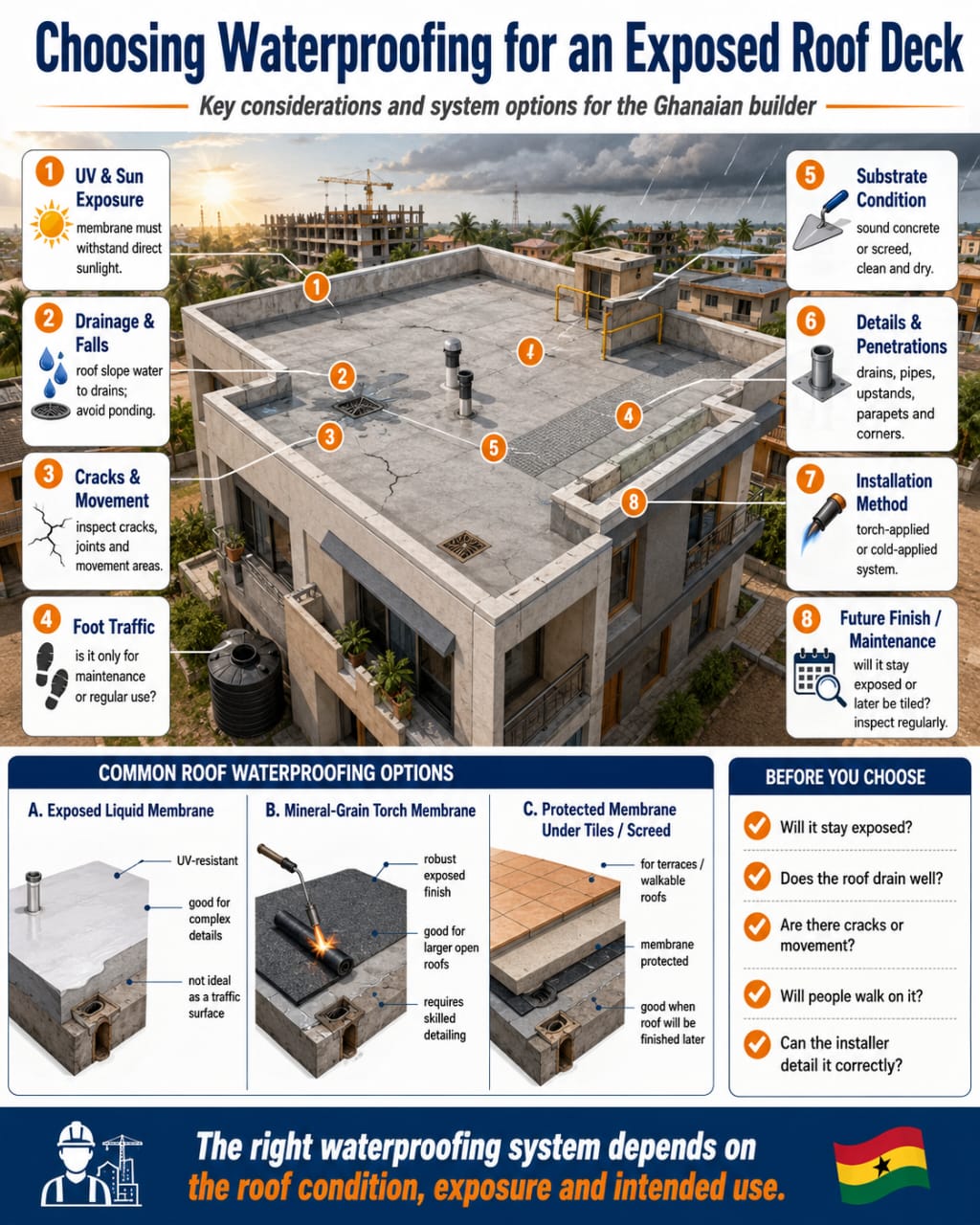
- ☀️ CAN THE WATERPROOFING SURVIVE PERMANENT SUNLIGHT AND UV?
This should be one of the first questions asked for an exposed Ghanaian roof.
If the membrane is going to remain uncovered, its manufacturer should specifically approve it for permanent external exposure and UV resistance.
For example, Sika Ghana describes Sikalastic®-505 BH as an elastic, UV-resistant liquid-applied membrane designed for exposed roofs and specifically suitable for hot and tropical climatic conditions.
Now compare this with bituminous membranes.
A mineral-granule surfaced APP membrane, such as the SikaShield P24 MG type, has mineral granules on its upper face specifically enabling permanent UV exposure.
But a polyethylene-faced membrane is different.
For example, Sika Ghana identifies SikaBit® PRO P-40-0 PE, a 4 mm APP torch-on membrane with polyethylene film on the top surface, for roofs under protective layers or ballast, terraces under tiles and as a base sheet in multi-layer systems.
That distinction matters enormously.
PE-FACED TORCH MEMBRANE ≠ AUTOMATICALLY AN EXPOSED FINISH.
If you want torch-on membrane to remain permanently exposed, specify an appropriate UV-protected cap sheet—typically a compatible mineral-granule surfaced membrane—rather than assuming every 4 mm membrane can remain uncovered.
- 💧 DOES THE ROOF DRAIN PROPERLY?
Before discussing waterproofing, look at the roof after heavy rain.
Ask:
Where does the water go?
A waterproofing contractor should never use membrane selection as a substitute for proper roof drainage.
The roof should have intentional falls directing water towards adequately sized:
- roof drains;
- scuppers;
- gutters;
- rainwater pipes;
- and emergency overflows where required.
There should not be unexplained depressions and backfalls trapping water across the roof.
As a useful international design benchmark, flat-roof guidance commonly aims to design adequate falls with allowances for construction tolerances and structural deflection; BS flat-roof guidance has traditionally used approximately 1:40 design fall to help achieve around 1:80 minimum finished drainage falls. Actual project requirements must follow the engineer’s design and applicable project standards.
Remember:
Waterproofing controls water penetration.
Slope controls where the water goes.
You need both.
This becomes even more important when selecting liquid-applied exposed membranes.
For instance, Sika’s Ghana data for Sikalastic-505 BH specifically states that the membrane should not be subjected to permanent water immersion.
So if your roof looks like a shallow swimming pool every time it rains, don’t immediately blame the waterproofing.
Fix the drainage.
- 🧱 IS THE ROOF CRACKED—and WILL THOSE CRACKS MOVE?
Concrete moves.
Roof slabs heat up during the day and cool afterwards. Buildings also experience shrinkage, structural movement and differential movement between different construction materials.
So inspect the roof carefully.
Are there:
hairline cracks?
structural cracks?
construction joints?
expansion joints?
old repaired cracks?
junctions between concrete and blockwork?
These conditions influence whether you need a rigid system, flexible system or reinforced flexible membrane.
Elastic liquid-applied roof membranes can be advantageous where crack-bridging and movement accommodation are required.
Sika’s guidance for Sikalastic-505 BH, for example, allows reinforcement using products such as Reemat or Flexitape around areas of high movement, cracks, joints, seams and complex details.
But never assume that simply coating over an active structural crack solves the problem.
The crack itself must first be understood.
A structural engineer may need to determine whether a crack is:
dead, active, structural or non-structural.
Waterproofing follows that diagnosis.
- 👣 WILL PEOPLE WALK ON THE ROOF?
This question changes the waterproofing specification completely.
There is a major difference between:
Roof A:
Only accessed occasionally by a technician cleaning gutters.
and
Roof B:
Used every weekend as a rooftop terrace with chairs, tables, children, parties and foot traffic.
The same exposed membrane may not be appropriate for both.
For example, Sika Ghana specifically states that Sikalastic-505 BH is not recommended as a pedestrian traffic surface and should receive suitable paving protection where pedestrian use is required.
That means:
If the roof will become a usable terrace, specify it as a terrace—not simply as an exposed roof.
You may need a system such as:
structural slab
→ screed to falls
→ waterproofing membrane
→ protection layer
→ drainage/protection build-up
→ tiles, pavers or another trafficable finish.
Your waterproofing can remain safely below while the finishing system handles traffic.
- 🏢 WHAT CONDITION IS THE EXISTING SUBSTRATE IN?
The most expensive waterproofing membrane in the world can fail when installed over a weak substrate.
Before waterproofing, ask:
Is the concrete sound?
Is there laitance?
Is the screed hollow?
Is the roof dusty?
Is there oil contamination?
Is there algae?
Is there old paint?
Is the substrate wet?
Is there an existing bituminous membrane?
Does the existing membrane have blisters?
Is moisture trapped beneath previous coatings?
These are waterproofing-design questions, not merely cleaning questions.
For example, the Ghana data for Sikalastic-505 BH specifies that new concrete should generally be cured for at least 28 days and requires suitable substrate preparation, including removal of weak concrete and correction of voids and defects.
Similarly, Sika’s Ghana guidance for torch-applied bituminous roofing requires the substrate to be uniform, firm, smooth, dry and free of contaminants and sharp protrusions before installation.
Waterproofing does not strengthen a failed screed underneath it.
If the substrate fails, the membrane attached to it can fail with it.
- 🔧 HOW COMPLICATED IS THE ROOF?
Stand on the roof and count the details.
How many:
- drains?
- parapets?
- corners?
- pipe penetrations?
- electrical conduits?
- AC supports?
- solar panel bases?
- water-tank bases?
- skylights?
- expansion joints?
- door thresholds?
- changes in level?
These are often where roofs leak.
Not necessarily in the middle of the slab.
WATERPROOFING FAILURE USUALLY LOVES DETAILS.
This is one area where liquid-applied membranes can be particularly attractive.
Because they are applied as liquids, they can form a seamless membrane around complicated geometry without requiring every shape to be formed from a prefabricated roll.
Sika specifically lists exposed roofs with many details and complex geometry among the intended uses of Sikalastic-505 BH.
Torch-on membrane, on the other hand, can be highly robust across broad open areas, but every:
overlap, termination, internal corner, external corner, pipe and drain
must be correctly cut, welded and detailed.
Sika’s installation guidance specifically calls for careful sealing around upstands, drains, vent pipes and other penetrations.
- 🔥 CAN YOU SAFELY USE AN OPEN FLAME?
Torch-applied bituminous systems require controlled heat from a gas burner.
On a large open concrete roof, an experienced applicator may be able to execute this safely.
But consider refurbishment projects containing:
- timber;
- combustible insulation;
- old roofing materials;
- electrical installations;
- gas lines;
- confined corners;
- sensitive equipment.
A cold-applied liquid system removes the need for torching.
Sika describes its liquid-applied exposed roof systems as cold applied, and products such as Sikalastic-560 require no heat or flame during installation.
The point is not that one method is automatically better.
The point is:
INSTALLATION METHOD IS PART OF PRODUCT SELECTION.
- 🌡️ HOW MUCH MOVEMENT AND WEATHER EXPOSURE WILL THE MEMBRANE EXPERIENCE?
The exposed membrane is now the building’s outer skin.
There is no screed protecting it.
No tiles shielding it.
No gravel covering it.
So elasticity, weathering performance and crack-bridging capacity become much more important.
Ghana’s Meteorological Agency reports year-round warm tropical conditions together with wet/dry seasonal cycles and increasing weather variability.
A dark roof membrane also absorbs more solar energy than a light reflective surface.
This is one reason some exposed liquid membranes are available in white reflective finishes.
Sika Ghana notes that Sikalastic-505 BH can increase solar reflection relative to darker substrates, potentially reducing heat gain and associated cooling demand.
For a warehouse, office or top-floor residence, roof colour and thermal behaviour can therefore be part of the waterproofing decision—not just aesthetics.
- 🏗️ WILL THE WATERPROOFING REMAIN EXPOSED OR BE COVERED LATER?
This question must be answered before installation.
Suppose a homeowner tells you:
«“Just waterproof it now. Maybe next year we’ll tile the rooftop.”»
That future intention matters.
Some exposed coating systems should not simply have cementitious tile adhesive applied directly over them.
For example, Sika Ghana specifically warns against applying cementitious materials such as tile adhesives directly over Sikalastic-505 BH without an appropriate engineered detail.
Meanwhile PE-faced torch membranes such as SikaBit PRO P-40-0 PE are specifically intended for applications beneath protective layers, ballast or tiles.
So determine the final roof build-up.
TODAY’S WATERPROOFING SHOULD NOT CREATE TOMORROW’S COMPATIBILITY PROBLEM.
- 🧪 CAN A CEMENTITIOUS WATERPROOFING PRODUCT SIMPLY BE LEFT EXPOSED?
This deserves special attention because cementitious waterproofing products are sometimes used indiscriminately.
Cementitious systems such as SikaTop Seal-107 can be excellent in the correct application—particularly beneath tiles, screeds and other protected wet-area systems.
But that does not automatically make them the first choice as a permanently exposed weathering membrane.
Current regional Sika technical guidance for SikaTop-107 states that when used on roofing or structures directly exposed to UV, the waterproofing should receive a protective cement screed.
This is exactly why product classification matters.
BATHROOM WATERPROOFING ≠ EXPOSED ROOF WATERPROOFING.
SWIMMING-POOL WATERPROOFING ≠ EXPOSED ROOF WATERPROOFING.
BASEMENT WATERPROOFING ≠ EXPOSED ROOF WATERPROOFING.
The environment determines the system.
- 🛠️ CAN THE CONTRACTOR ACTUALLY INSTALL THAT SYSTEM PROPERLY?
A technically excellent waterproofing product can be destroyed by poor workmanship.
Torch membranes depend heavily on:
correct priming,
uniform torching,
full bonding,
correct overlaps,
proper welding,
accurate detailing.
Liquid-applied systems depend heavily on:
surface preparation,
correct primer selection,
specified consumption,
film thickness,
reinforcement placement,
waiting times,
weather conditions during application.
Applying “two coats” tells you almost nothing unless you know how much material was actually installed.
A contractor could theoretically spread two extremely thin coats and still say:
“Boss, we did two coats.”
Waterproofing performance comes from installing the specified system thickness and consumption, not counting brush strokes.
- 🔍 WHAT MAINTENANCE WILL THE OWNER PROVIDE?
There is no exposed roof that should simply be forgotten forever.
After installation, the owner should periodically inspect:
- outlets;
- gutters;
- membrane surfaces;
- parapets;
- joints;
- penetrations;
- sealants;
- solar installations;
- plant bases;
- signs of mechanical damage.
Sika’s Ghana guidance for both exposed liquid coatings and bituminous roofing recognises periodic inspection and maintenance as part of retaining long-term waterproofing performance.
This is especially important after somebody installs:
a satellite dish, AC unit, solar frame, water tank or new pipe
on a previously waterproofed roof.
The waterproofing contractor cannot protect a membrane from a plumber drilling straight through it six months later.
SO WHICH TYPE OF WATERPROOFING SHOULD YOU CHOOSE?
There is no universal answer, but a practical decision framework looks like this:
✅ EXPOSED ROOF WITH COMPLEX DETAILS
A properly specified UV-resistant elastic liquid-applied roofing membrane can be very effective.
Example: Sikalastic®-505 BH, subject to substrate, drainage, movement and traffic requirements.
✅ LARGE OPEN ROOF WHERE TORCH APPLICATION IS SUITABLE
A properly designed APP modified bituminous roofing system can provide a robust solution.
If the membrane will remain exposed, specify an appropriate mineral-granule UV-resistant cap sheet, not merely a PE-faced underlayer.
✅ ROOFTOP TERRACE TO BE TILED OR PAVED
Consider a protected waterproofing system underneath the trafficable finish, rather than expecting an ordinary exposed coating to function as a walking surface.
✅ CEMENTITIOUS WATERPROOFING
Excellent for appropriate protected applications, including many undertile systems, but do not automatically treat it as a permanently exposed roof membrane. Manufacturer guidance may require protective screed when directly UV exposed.
THE GHANAIAN BUILDER’S ROOF WATERPROOFING CHECKLIST
Before specifying anything, answer these questions:
- Is the membrane going to remain exposed?
- Is the chosen product specifically UV resistant?
- Does the roof have proper falls and adequate drainage?
- Is there persistent ponding water?
- Are there cracks or structural movement?
- Will the roof carry pedestrian traffic?
- What is the condition and moisture level of the substrate?
- How many drains, penetrations, parapets and difficult details exist?
- Is torch application safe and practical?
- Will tiles, screed, paving or another finish eventually cover the membrane?
- Can the installer achieve the specified preparation, thickness and detailing?
- Who will inspect and maintain the roof afterwards?
Only after answering those questions should you ask:
“Which waterproofing product should we use?”
THE BIG LESSON
A roof does not fail simply because someone bought a “bad waterproofing product.”
Many waterproofing failures begin much earlier:
Wrong system for the exposure.
Wrong membrane for the traffic.
Poor slope.
Blocked drains.
Unrepaired cracks.
Wet or weak substrate.
Bad detailing.
Incorrect thickness.
Using a membrane designed to be covered and leaving it exposed.
Using an exposed membrane and later burying it under an incompatible finishing system.
That is why professional waterproofing is not about finding the strongest product on the shelf.
IT IS ABOUT SELECTING THE RIGHT SYSTEM FOR THE CONDITIONS.
Before waterproofing an exposed roof, don’t begin with:
“How many buckets do I need?”
Begin with:
“What does this roof need the waterproofing to do for the next 10, 15 or 20 years?”
Then specify the complete system around that requirement.
The best waterproofing product is not necessarily the most expensive one.
It is the one correctly selected, correctly detailed and correctly installed for the roof it is expected to protect.

