



How Concrete Admixtures Can Reduce Block Production Waste
Why Ghanaian Block Manufacturers Should Start Looking Seriously at Concrete Admixtures
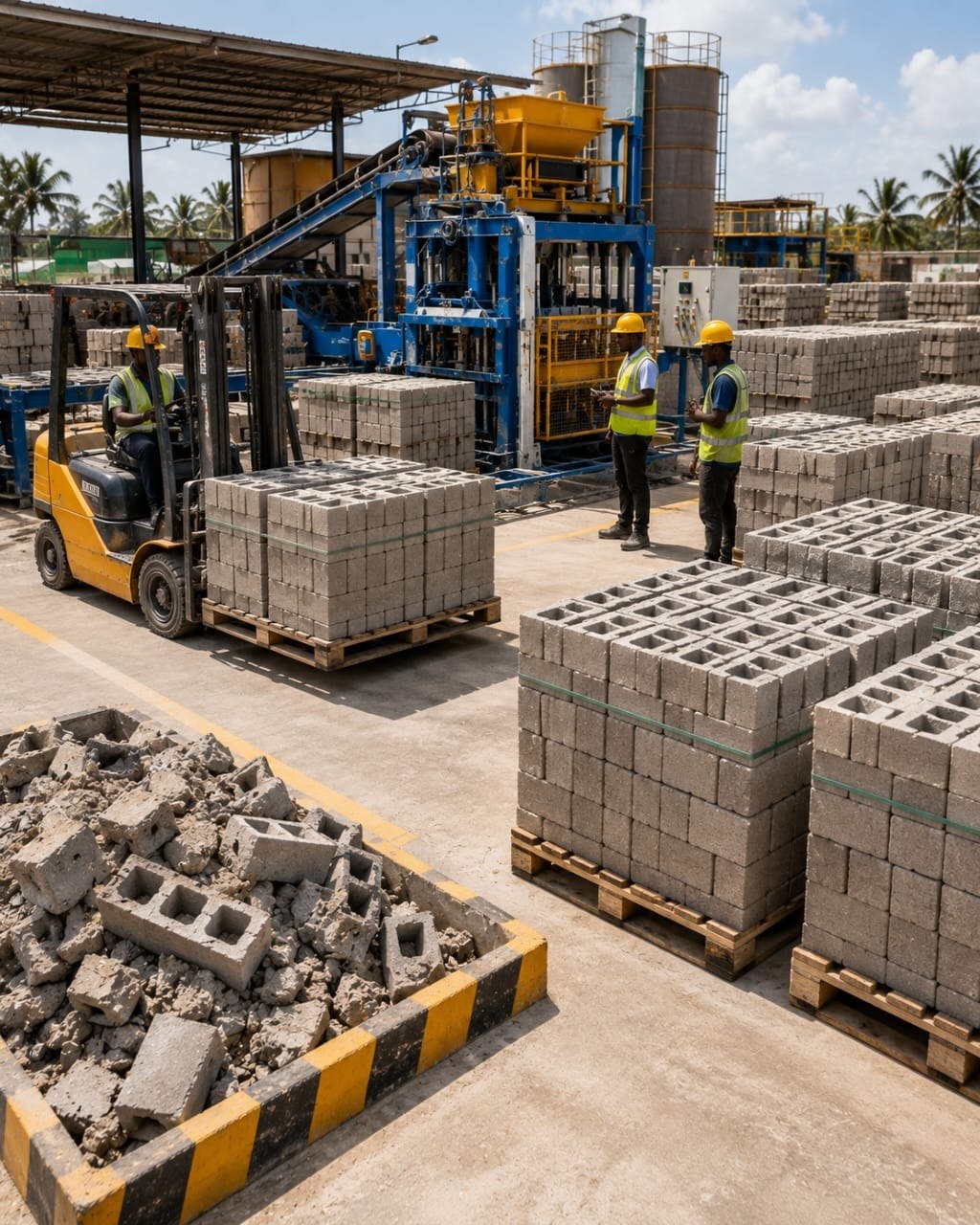
Walk through many block factories in Ghana and one thing is difficult to miss:
Broken blocks.
Blocks damaged during demoulding. Blocks chipped while stacking. Blocks cracked during loading. More losses during transportation. And sometimes, another batch is damaged when the blocks are finally offloaded at the project site.
One broken block may not look like much money.
But don’t calculate one block.
Calculate:
broken blocks per day × production days × months × the entire year.
That pile of broken blocks beside the factory is not simply waste.
It is cement, sand, water, labour, machine time, electricity or fuel—and profit—sitting on the ground.
Don’t Count Blocks Produced. Count Blocks You Can Sell.
Suppose your factory manufactures 10,000 blocks.
If 500 are lost through demoulding, stacking, handling, loading and transportation, you have not economically produced 10,000 saleable blocks.
You have produced:
9,500 saleable blocks + 500 pieces of paid-for waste.
Yet cement, aggregates, water, labour and machine time went into all 10,000.
This is why a block manufacturer’s real production cost should not simply be:
How much does it cost me to mould one block?
The better question is:
How much does it cost me to produce one SALEABLE block?
That difference matters.
Breakage Is Only One Part of the Loss
Some blocks survive transportation but still fail to achieve the compressive strength required by the customer, engineer or project specification.
The consequences can be even more expensive:
- rejected deliveries;
- replacement costs;
- customer complaints;
- project delays;
- damaged reputation; and
- loss of future contracts.
Producing blocks therefore cannot simply be a matter of combining cement, sand or aggregate and water according to habit.
For manufacturers who want greater consistency and efficiency, production has to become a controlled process involving mix design, water control, compaction, curing and quality testing.
One production tool worth understanding is the plasticising or compaction admixture for semi-dry concrete.
Why Semi-Dry Concrete Is Challenging
Block production presents an interesting balance.
Too little water can make a semi-dry mix difficult to distribute and compact properly.
But simply adding more water is not necessarily the answer. Uncontrolled water changes the water/cement ratio and can affect the properties of the hardened concrete.
What the manufacturer wants is a balance of:
GOOD MOULD FILLING + EFFECTIVE COMPACTION + CONTROLLED WATER/CEMENT RATIO + GOOD GREEN STRENGTH
Specialised semi-dry concrete admixtures can help manufacturers optimise this balance by improving the dispersion, lubrication and compaction characteristics of the mix.
Green Strength: The Strength You Need Before 28 Days
Block manufacturers often talk about compressive strength at 7 or 28 days.
But your block has to survive a lot before reaching 28 days.
Shortly after production, it may have to be:
demoulded, moved, stacked, handled, strapped, loaded, transported and offloaded.
The ability of the newly manufactured unit to retain its shape and withstand these early production and handling operations is commonly associated with its green strength.
Higher and more consistent green strength can contribute to:
fewer damaged edges + fewer cracked blocks + fewer handling losses + fewer rejected units.
That has a direct commercial value.
So Why Would I Spend Money on an Admixture?
This is where manufacturers should change the calculation.
Don’t ask only:
How much admixture am I adding per bag of cement?
Ask:
What can this production change save me per 1,000 acceptable blocks?
If a properly selected and tested admixture system helps reduce:
- demoulding losses;
- stacking damage;
- loading losses;
- transport breakage;
- inconsistent density;
- strength variation; and
- customer rejection,
then the admixture is not simply another chemical expense.
It becomes a production optimisation tool.
Better Compaction Can Mean a Better Block
Think about what happens inside the mould.
Poorly distributed or insufficiently compacted semi-dry concrete can contribute to:
- excessive voids;
- weak corners;
- poorly compacted edges;
- density variations;
- inconsistent dimensions; and
- localised weak zones.
The block may appear acceptable when it leaves the machine.
The problem may only become visible when somebody handles it, stacks another block on it, loads it onto a truck—or when the truck hits one of Ghana’s less forgiving roads.
The performance of the finished block therefore begins inside the mould.
The Real Business Question
The point is not that every block factory should immediately start pouring admixture into its mixer.
The point is that serious manufacturers should stop accepting high breakage and rejection rates as an unavoidable part of the business.
Measure them.
If your factory produces thousands of blocks every week, even a small percentage reduction in wastage can become significant over a year.
In Part 2 of this series, we will look at what semi-dry concrete admixtures actually do and compare three options relevant to block and precast production:
- SikaPaver® HC-200
- Weber ADMIX CMU 100
- Weber ADMIX SD PLAST 110
Because before deciding whether an admixture is expensive, you first need to understand what it is supposed to improve.
PRODUCE BETTER. WASTE LESS. SELL MORE.
Technical note: Product suitability, dosage and performance should be established through controlled trials using the manufacturer’s current technical documentation and the actual materials and production conditions at the factory.

