


Why Secret Roofs Leak in Ghana and How to Approach the Problem
At Avenue Construction Supply, one complaint we increasingly receive from homeowners and developers is:
“My secret roof leaks whenever it rains. What can you use to stop it?”
Secret roofs have become very popular on modern Ghanaian homes because the roofing sheets are concealed behind parapet walls, giving the building a clean, contemporary appearance.
When properly designed and constructed, they work very well.
However, when the roof-to-wall junction, flashing, concealed gutter, parapet or drainage system is poorly detailed, the secret roof can become a recurring source of leakage.
You may notice:
- water running down internal walls;
- damp ceilings;
- peeling paint;
- staining around the roof line;
- wet or deteriorating plaster;
- mould;
- or dripping that only appears during heavy rainfall.
In many cases, the first reaction is to apply silicone or another sealant around the visible leak.
The problem may disappear for a while.
Then the next heavy rain comes—and the leakage returns.
Our approach is different.
WE DO NOT START WITH THE PRODUCT. WE START WITH THE CAUSE.
Before recommending Sikaflex, Campolin Fiber, Sika MultiSeal, Sikalastic or any other product, we first need to establish:
Where is the water entering?
Why is it entering?
Where is it collecting?
How is the roof designed to drain?
Which parts of the system are moving?
A leaking secret roof is very often a detailing and drainage problem before it becomes a waterproofing-product problem.
WHY IS YOUR ROOF-TO-WALL JUNCTION SO IMPORTANT?
At a typical secret roof, several different materials and components meet in one relatively small area:
metal roofing + masonry or concrete wall + flashing + concealed gutter + joints + rainwater outlets.
These materials behave differently.
Under Ghana’s hot sun, the metal roofing heats up and expands.
During cooler periods and rainfall, it contracts.
The masonry or concrete wall moves differently.
At the same time, rainwater is running down the wall, across the roof and into the concealed gutter.
So this junction has to manage:
WATER + MOVEMENT + HEAT + UV + WIND + DRAINAGE
This is why filling the gap with cement mortar or applying ordinary silicone across the junction may not give you a lasting repair.
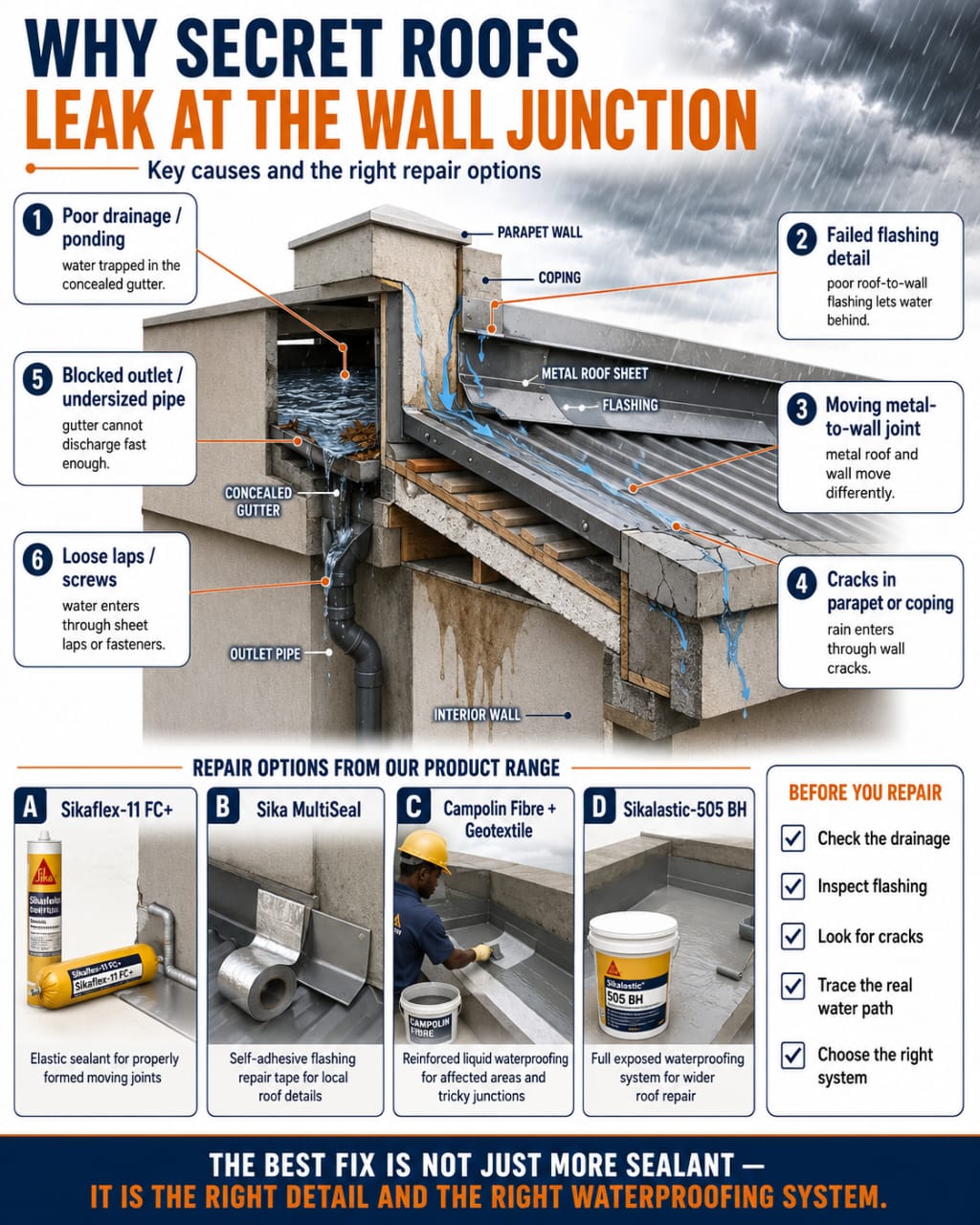
🔍 POSSIBLE CAUSE 1: YOUR ROOF DOES NOT HAVE A PROPER FLASHING DETAIL
Where your roof sheet meets a wall or parapet, there should be a properly designed flashing arrangement.
The purpose of the flashing is to collect rainwater coming down the wall and direct it safely back onto the roofing or into the drainage system.
The roofing sheet should not simply terminate against the wall with cement mortar packed around it.
If we inspect your roof and find that the flashing geometry itself is wrong, our first recommendation may be:
Correct or replace the flashing.
No waterproofing coating can permanently compensate for a fundamentally defective roof-to-wall detail.
🔍 POSSIBLE CAUSE 2: THE FLASHING TERMINATION HAS OPENED
Sometimes your flashing may be present but the point where it terminates against the wall has opened.
This is common because the metal roofing and masonry are moving differently.
For a properly prepared movement joint, one product we may recommend is:
✅ SIKAFLEX®-11 FC+
Sikaflex-11 FC+ is an elastic construction adhesive and sealant suitable for materials such as:
- concrete;
- masonry;
- metal;
- and other common construction substrates.
Its elasticity allows it to accommodate movement much better than rigid cement mortar.
However, we do not simply squeeze Sikaflex over an old, deteriorated joint.
Depending on the condition, we may first:
- remove failed sealant;
- remove loose mortar;
- clean the joint;
- ensure the surrounding materials are sound;
- properly form the joint;
- and prepare the surfaces before applying the sealant.
Our principle is simple:
Sikaflex should seal a properly constructed joint—not hide a defective one.
🔍 POSSIBLE CAUSE 3: WATER IS PASSING BEHIND YOUR FLASHING
For suitable localised flashing and roofing-sheet repairs, we may also use:
✅ SIKA® MULTISEAL
Sika MultiSeal is an aluminium-faced, self-adhesive bituminous sealing tape.
It can be useful around suitable:
- roofing-sheet details;
- flashings;
- gutters;
- roof penetrations;
- and local repair areas.
For example, where an additional waterproof flashing layer is required between properly prepared metal and masonry surfaces, Sika MultiSeal can provide an effective repair solution.
But again, surface preparation is critical.
We will not recommend applying MultiSeal onto:
dusty surfaces, wet concrete, loose paint, algae or weak plaster.
The substrate must first be made suitable to receive the waterproofing.
🔍 POSSIBLE CAUSE 4: YOUR CONCEALED GUTTER IS HOLDING TOO MUCH WATER
This is one of the first areas we check.
We ask:
WHERE DOES ALL THE RAINWATER GO ONCE IT ENTERS YOUR SECRET ROOF?
Your concealed gutter or concrete drainage channel may be receiving a huge amount of rainwater during a heavy Ghanaian storm.
Problems arise where the gutter has:
- insufficient slope;
- depressions;
- blocked outlets;
- undersized rainwater pipes;
- debris;
- badly positioned drains;
- or inadequate overflow provision.
Water then starts to build up.
Once the water level rises high enough, it may pass above the flashing or find the weakest joint in the system.
Waterproofing cannot replace good drainage.
If this is what we find on your roof, we may recommend correcting:
the gutter falls, outlets, pipe sizes or drainage arrangement before carrying out the waterproofing repairs.
🔍 POSSIBLE CAUSE 5: YOUR CONCEALED GUTTER OR ROOF-TO-WALL JUNCTION IS CRACKED
This is one area where one of the systems we stock can be particularly useful:
✅ CAMPOLIN FIBER + GEOTEXTILE REINFORCEMENT
Campolin Fiber is a fibre-reinforced acrylic liquid waterproofing membrane suitable for several external applications including:
- roofs;
- parapets;
- vertical walls;
- drainage details;
- balconies;
- sheet roofing;
- and previously waterproofed surfaces.
Because it forms an elastic waterproof membrane, it can be particularly useful where your roof contains:
- troublesome cracks;
- complicated corners;
- irregular gutter geometry;
- wall-to-roof junctions;
- or previously repaired areas.
WHY MAY WE ADD GEOTEXTILE TO CAMPOLIN FIBER?
Campolin Fiber already contains reinforcement fibres within the coating.
However, particularly vulnerable areas may require additional textile reinforcement.
On your roof this may include:
roof-to-wall junctions
concealed gutter corners
difficult cracks
sheet-to-masonry interfaces
changes in level
previously leaking areas
penetrations
perimeter details
In such situations, we may embed a compatible geotextile reinforcement into the wet Campolin Fiber membrane.
The geotextile does not simply make the coating thicker.
Its purpose is to reinforce the vulnerable section and help distribute stresses across a wider waterproofing area.
A simple way of understanding the system is:
Campolin Fiber provides the waterproofing and elasticity.
The geotextile reinforces the vulnerable detail.
HOW MAY WE APPLY A REINFORCED CAMPOLIN FIBER SYSTEM?
The exact method will depend on the condition of your roof, but a typical remedial approach may include:
- Prepare the surface
We remove:
- loose coatings;
- weak screed;
- dirt;
- algae;
- dust;
- debris;
- and poorly adhered material.
- Repair defective areas
Cracks, weak screed, damaged render and defective substrates should be repaired before the waterproofing system is installed.
Major or potentially structural cracks should first be properly investigated.
- Apply the initial Campolin Fiber coat
The waterproofing material is worked properly into the prepared substrate.
- Embed the geotextile reinforcement
While the coating is still wet, we place the compatible geotextile over the vulnerable area.
The membrane should lie smoothly without:
- wrinkles;
- trapped voids;
- dry sections;
- or poorly bonded edges.
- Fully encapsulate the reinforcement
Additional Campolin Fiber is then applied so that the geotextile becomes completely incorporated into the waterproofing membrane.
- Apply the subsequent coats
After the appropriate drying period, additional material is applied to create a continuous waterproofing system extending sufficiently beyond the original defect.
And this is important:
We do not assess a waterproofing job simply by saying:
“We applied three coats.”
The more important consideration is whether the correct material consumption, membrane thickness and detailing have been achieved.
🔍 POSSIBLE CAUSE 6: A LARGE PART OF YOUR SECRET ROOF HAS FAILED
Sometimes we inspect a roof and discover that the problem is no longer one isolated joint.
There may be:
- numerous cracks;
- multiple penetrations;
- deteriorated old waterproofing;
- several wall junctions;
- a leaking concealed gutter;
- or a generally complicated roof configuration.
In such cases, constantly patching individual leaks may not be economical.
We may recommend treating a larger area as a continuous waterproofing system.
Two possible options from our range include:
OPTION A — CAMPOLIN FIBER SYSTEM
Campolin Fiber can be used across the wider prepared area, while vulnerable joints, perimeters and difficult details are reinforced with compatible geotextile where necessary.
This allows us to create a more continuous waterproofing envelope instead of chasing individual leak points.
OPTION B — SIKALASTIC®-505 BH
For certain roofs, we may recommend:
✅ SIKALASTIC®-505 BH
Sikalastic-505 BH is an elastic, cold-applied and UV-resistant liquid roofing membrane suitable for exposed roofs.
It becomes particularly useful where your roof has:
- complicated geometry;
- several details;
- joints;
- cracks;
- penetrations;
- or difficult areas around parapets and gutters.
Appropriate reinforcement can also be introduced around vulnerable joints, dynamic cracks, seams and complicated details.
The exact choice between Campolin Fiber, Sikalastic-505 BH or another waterproofing system will depend on what we find during the inspection.
🔍 POSSIBLE CAUSE 7: THE PARAPET WALL IS ACTUALLY WHERE THE WATER ENTERS
Sometimes your roofing sheet is not the problem at all.
Water may be entering through cracks higher up the parapet wall.
We therefore inspect:
- rendered walls;
- cracks;
- deteriorated blockwork;
- failed paint;
- penetrations;
- coping joints;
- and the parapet surface.
Water can enter above the roof, travel behind the render and eventually appear inside your building at the roof level.
Where you see the water is not necessarily where the water entered.
This is why a professional inspection must follow the entire water path.
Campolin Fiber may also be useful for suitable repaired parapet and vertical-wall waterproofing applications where required.
🔍 POSSIBLE CAUSE 8: WATER IS ENTERING FROM THE TOP OF THE PARAPET
Your parapet coping may also be responsible.
We look for:
- cracks;
- open coping joints;
- incorrect slopes;
- missing drip details;
- and areas where water can enter directly into the wall.
If water is getting into the parapet from the top, repeatedly sealing the roof-to-wall junction below may never solve the problem.
Our inspection therefore considers the whole assembly:
ROOF + GUTTER + FLASHING + PARAPET FACE + PARAPET TOP
🔍 POSSIBLE CAUSE 9: THE METAL ROOF ITSELF MAY BE LEAKING
We also check the roofing sheets.
Potential defects include:
- loose screws;
- failed rubber washers;
- insufficient overlaps;
- defective end laps;
- holes;
- corrosion;
- valleys;
- sheet edges;
- and roof penetrations.
Water can enter several metres away and travel underneath the roofing sheet before appearing at the wall junction.
That is why we do not automatically repair the first place where we see a stain.
🔍 POSSIBLE CAUSE 10: THE ROOF PITCH OR GUTTER FALL MAY BE WRONG
Waterproofing works best when the roof geometry is helping it.
If the roofing sheet has insufficient pitch or your concealed gutter has backfalls, water stays against vulnerable junctions much longer than necessary.
In this situation, the lasting solution may require us to first correct the drainage geometry.
Another coating alone will not solve a badly sloped roof.
SO WHICH PRODUCT WILL WE USE ON YOUR ROOF?
That depends entirely on what has failed.
✅ Moving metal-to-wall joint
Sikaflex®-11 FC+
For suitably prepared elastic joints where movement needs to be accommodated.
✅ Local flashing or roofing-sheet repair
Sika® MultiSeal
For suitable flashing, sheet-metal and local sealing details.
✅ Cracked concealed gutter / difficult wall junction
Campolin Fiber + compatible geotextile reinforcement
For reinforced liquid waterproofing across vulnerable leak-prone areas.
✅ Larger complicated exposed roof
Campolin Fiber or Sikalastic®-505 BH
The final selection will depend on:
- your existing substrate;
- roof geometry;
- existing waterproofing;
- degree of movement;
- water exposure;
- and extent of deterioration.
✅ Defective flashing
We correct the flashing first.
There is no waterproofing product that should be expected to permanently replace proper flashing geometry.
✅ Ponding concealed gutter
We correct the drainage first.
We do not want to create a swimming pool behind your parapet and then depend entirely on a coating to hold the water indefinitely.
OUR PRACTICAL APPROACH TO REPAIRING YOUR SECRET ROOF
Depending on what we find during inspection, a comprehensive repair may involve:
- Correcting roof and gutter drainage
- Repairing defective concrete, screed and masonry
- Properly forming or replacing defective flashing
- Applying Sikaflex®-11 FC+ to appropriate movement joints
- Using Sika® MultiSeal at suitable flashing and local repair details
- Applying Campolin Fiber with compatible geotextile reinforcement across vulnerable joints and affected areas
- Applying Campolin Fiber or Sikalastic®-505 BH across the wider exposed waterproofing area where necessary
- Repairing and waterproofing parapets, penetrations and coping details
This is what we call:
A WATERPROOFING SYSTEM—NOT A PATCH.
WHAT WE WOULD NOT RECOMMEND FOR YOUR ROOF
❌ Filling the metal-to-wall joint with cement mortar
Metal roofing moves repeatedly. Rigid mortar does not accommodate that movement effectively.
❌ Applying silicone everywhere
Sealant cannot correct poor flashing or bad drainage.
❌ Waterproofing over dirty, wet or deteriorated surfaces
A membrane can only perform properly when the substrate supporting it is sound.
❌ Placing geotextile dry over the finished waterproofing
Where reinforcement is required, it should be correctly embedded and encapsulated within the compatible membrane system.
❌ Repairing one tiny area when the surrounding system has failed
We first determine the actual extent of the defect.
❌ Ignoring drainage
Before waterproofing, we want to know:
Where is the water supposed to go?
OUR MESSAGE TO YOU
When you contact us and say:
“My secret roof leaks whenever it rains. Which product should I buy?”
we do not want our first response to be:
“Buy this bucket.”
We would rather first establish:
Where is the water entering?
Where is it collecting?
Is your flashing correctly formed?
Is the joint moving?
Is the concealed gutter cracked?
Are the outlets adequate?
Is the parapet leaking?
Does the affected area require reinforcement?
Only after understanding the failure can we correctly specify products such as:
Campolin Fiber
Compatible geotextile reinforcement
Sikaflex®-11 FC+
Sika® MultiSeal
Sikalastic®-505 BH
and assign each one to the job it is designed to perform.
BUILD RIGHT. BUILD SURE.
Your leaking secret roof does not necessarily need more waterproofing.
It needs the right waterproofing, applied in the right place, over the right construction detail.
At Avenue Construction Supply / Wallcare & Waterproofing, our objective is not simply to sell you a waterproofing product.
We want to help identify the cause of the leakage and recommend a system that addresses the problem properly.

