


Rising Damp in Ghana: How to Prevent It at Foundation Level
A common mistake on Ghanaian building sites is to think about dampness only after the building has been completed.
Then the signs begin to appear: paint starts peeling around the bottom of the walls, plaster becomes powdery, skirting areas develop stains, rooms smell damp, and the mason is called back to “apply waterproofing.”
But by then, the real problem may already be buried beneath the building.
The best way to deal with rising damp is to prevent moisture from entering the building in the first place.
And that requires more than one product.
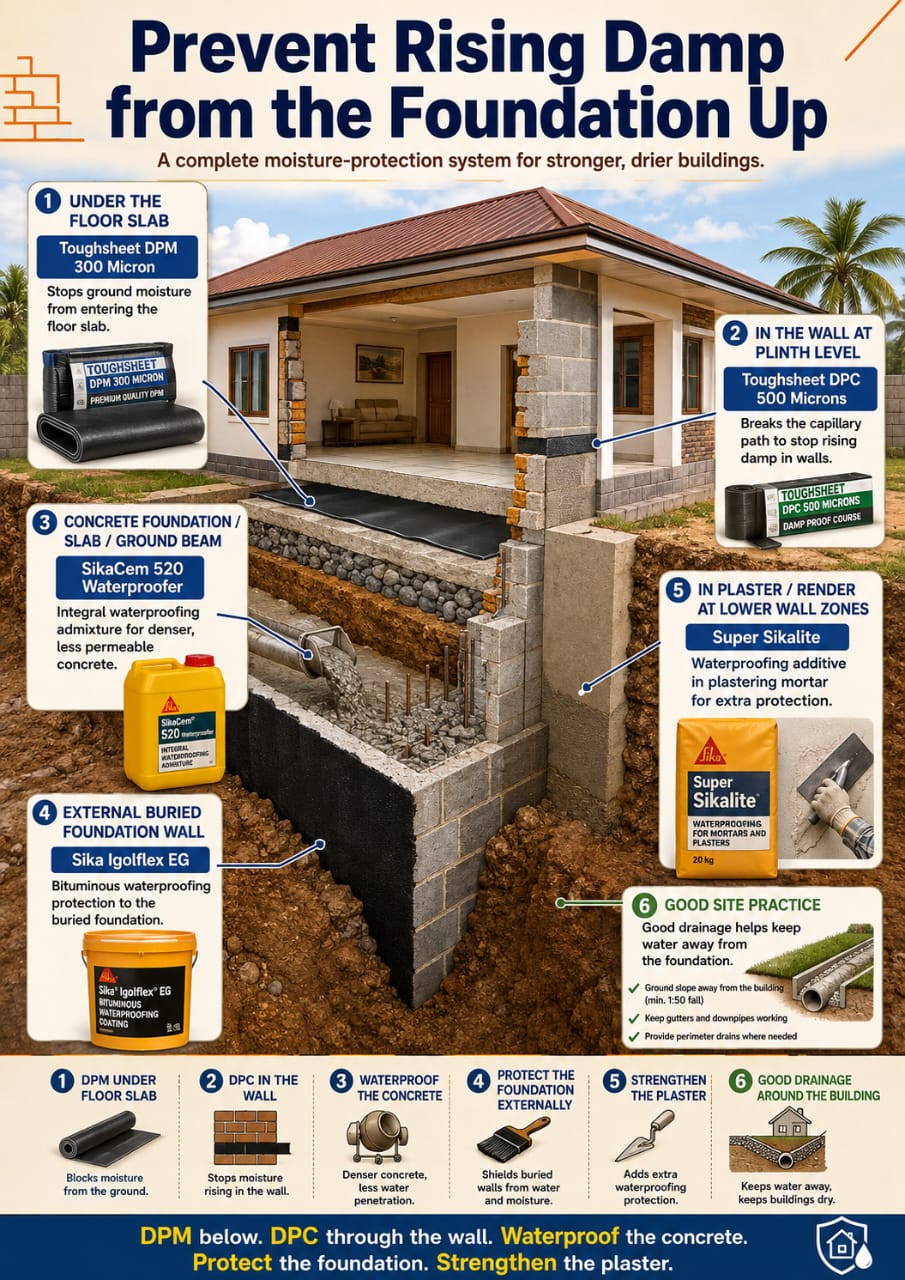
A properly protected foundation should combine good drainage, a Damp Proof Membrane (DPM), Damp Proof Course (DPC), water-resistant concrete, external foundation protection and properly treated plastering mortar.
Think of it as several lines of defence working together.
Start Under the Floor: Install a Proper DPM
Ground moisture should never be allowed to travel directly into your floor slab.
This is where a Damp Proof Membrane — DPM — becomes important.
A product such as Toughsheet 300-micron DPM is a polyethylene membrane designed to form a barrier between the ground and the concrete floor construction. Toughsheet identifies its 300-micron membrane specifically for protecting concrete floors and structures against ground moisture and water vapour.
It should be properly laid over the prepared substrate, with joints and penetrations carefully sealed and the membrane protected from puncturing during reinforcement and concreting.
The important word here is continuity.
A very good DPM with holes from reinforcement, careless walking, plumbing penetrations or poor jointing is no longer a complete moisture barrier.
Stop Moisture Travelling Up the Walls: Install Your DPC
A DPM protects primarily against moisture coming through the floor.
The wall requires its own horizontal barrier.
That is the job of the Damp Proof Course — DPC.
For example, Toughsheet 500-micron DPC is manufactured specifically as a barrier against rising damp in brick, block, stone and concrete wall construction. The manufacturer’s standard product is 500 microns thick and is manufactured to BS 6515:84.
The DPC creates a physical break in the capillary path through which moisture would otherwise travel upwards through blockwork and mortar joints.
But simply placing a strip of DPC somewhere in the wall is not enough.
The DPC should be positioned and detailed so that it works together with the floor DPM. Your DPM and DPC must form part of one continuous damp-proofing strategy.
Otherwise, water will simply find the weakest route around them.
Make the Foundation Concrete Less Permeable
The next line of defence is the concrete itself.
Concrete may look solid, but it contains pores and capillary pathways through which moisture can migrate.
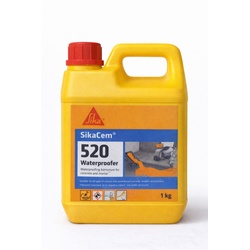
This is where an integral waterproofing admixture such as SikaCem®-520 Waterproofer GH becomes useful.
SikaCem-520 Waterproofer is designed for waterproof mortars and concretes, including foundations, basements and walls, and works by obstructing the concrete’s capillary network.
The recommended dosage is 0.5%–2.0% by weight of the total cementitious material, with trial mixes recommended to establish the appropriate dosage.
So for a typical 50 kg bag of cement, that represents approximately 0.25 kg to 1.0 kg of SikaCem-520, depending on the mix design and required performance.
It should be introduced through the mixing water or towards the end of mixing. Sika specifically advises that it should not be added directly into the dry concrete or mortar mix.
This does not replace your DPM or DPC.
Instead, it gives you another layer of protection by reducing the ease with which water can move through properly designed and compacted concrete.
Protect the Outside of the Foundation Before Backfilling
Once your foundation walls, ground beams or other below-ground concrete surfaces are completed, remember what happens next:
you are going to bury them.
Once backfilled, correcting a waterproofing mistake becomes much more difficult and expensive.
Before backfilling, exposed foundation surfaces that will remain in contact with soil can therefore receive an external bituminous damp-proof coating such as Sika® Igolflex®.
Sika identifies Igolflex bituminous systems for below-ground waterproofing and protection, including foundations, retaining walls and basements.
For the Sika Igolflex-155 EG system, the regional product data describes it specifically for damp-proofing concrete foundations in contact with soil and calls for multiple coats over a properly prepared substrate.
The principle is simple:
Don’t allow wet soil to sit permanently against unprotected porous concrete or masonry and expect the internal wall to remain dry forever.
Treat the water from the side where it is coming from whenever possible.
And remember that the coating must also be protected from damage during backfilling.
Give Your Plastering Mortar Its Own Protection
Now we come above ground.
Even after properly protecting the foundation, it makes sense to improve the moisture resistance of plastering and rendering mortar, particularly around vulnerable lower wall areas.
One practical option is Super Sikalite®, a powder waterproofing additive designed for cement mortars and concrete.
According to Sika, Super Sikalite improves waterproofing, promotes compactness and can reduce shrinkage by reducing mixing-water demand.
The recommended dosage is conveniently suited to our common Ghanaian cement packaging:
1 kg of Super Sikalite for 50 kg of cement.
It should be introduced into the mixer at the same time as the cement.
Again, this is important:
Waterproofing additive in plaster should be considered an additional defence — not a substitute for a missing DPC or DPM.
If groundwater has already been allowed unrestricted access into the wall, simply adding a waterproofing additive to the finishing plaster does not correct the fundamental construction defect.
And Don’t Forget the Water Outside the Building
Even the best waterproofing materials can be challenged by poor building design.
Your external ground levels should direct rainwater away from the building, not towards the foundation.
Gutters and downpipes should discharge properly. Stormwater should have somewhere to go. Where groundwater conditions are severe, proper drainage and a professionally designed below-ground waterproofing system may be required.
This becomes particularly important on waterlogged sites, basement projects or areas with a high water table. Sika’s own below-grade waterproofing guidance notes that external waterproofing and good drainage work together to prevent water pressure building against underground structures.
So What Should a Ghanaian Builder Do?
From the soil upwards, think of your protection like this:
Ground → Toughsheet 300-micron DPM → Waterproofed/low-permeability concrete using SikaCem-520 → Toughsheet 500-micron DPC beneath the wall → Sika Igolflex protection to buried external foundation surfaces → Super Sikalite in appropriate plastering/rendering mortar.
Each one has a specific job.
Together, they make it much more difficult for ground moisture to find its way into the occupied building.
Don’t Wait for Rising Damp to Teach You About Waterproofing
Waterproofing at foundation stage may look like an additional cost when the building is coming out of the ground.
But compare that with having to remove paint, hack off plaster, inject walls, excavate foundations, replace damaged finishes and explain to a homeowner why a relatively new building already smells damp.
Rising damp is much cheaper to prevent than to repair.
So before you cast the floor, before you start the blockwork and definitely before you backfill the foundation, ask yourself:
“Where will the water try to enter—and what have I put there to stop it?”
DPM below. DPC through the wall. Waterproof the concrete. Protect the foundation. Strengthen the plaster.
Because good waterproofing does not start when the building begins to leak.
It starts from the foundation.

